What's All This Then?
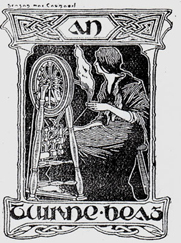
an tuirne beag
The Little Spinning Wheel

An Tuirne Beag (The Little Spinning Wheel) is a miraculous cultural survival. Its collection of artifacts are now housed in the Ballycastle Museum on Castle Street, Ballycastle, County Antrim where they were moved after the original Anne Street site of the An Tuirne Beag shop was sold in 1982. The shop site was redeveloped and is currently occupied by Wysner’s butcher shop.
Initially trading under the nomenclature of the Irish Peasant Home Industries An Tuirne Beag was established in 1903 by local philanthropist Frances Riddell with the financial assistance of F. J. Bigger and was a signature venture in the history of the Irish Cultural Revival (1870-1914).
Many of those involved in the Revival were influenced by the social ideas of William Morris (1834-96)) the visionary architect, craftsman, poet who founded the English Arts and Crafts Movement. One of his significant ideas was that money could be attracted into deprived rural areas with the establishment of local craft industries. Ideally, the rural poor would benefit from the physical security that local employment offered while the rural landscape would be protected from the blight of industrial urban sprawl. The entire rural community at every social level would be enriched by what was described by the Irish playwright J.M Synge as ‘the artistic beauty of mediaeval life’.
An Tuirne Beag was run as a local charitable concern with the initial set up costs covered by a financial gift from F.J. Bigger. Frances Riddell herself worked gratis. Any income generated went directly and solely to the craft workers. The workshop produced toys and furniture, crafted by local young men trained by the concern’s manager Stephen Clarke. Clarke was an Antrim man, an extremely talented woodworker, born and raised locally at Murlough Bay.
The store premises of An Tuirne Beag / The Little Spinning Wheel on Castle Street, Ballycastle were “fitted up as an old Irish kitchen, enhanced in every way by every feature of interest and sentiment likely to appeal to those whose fancy leads them to admire old times, old customs, old ways’ and the walls ‘were covered with local relics of the past – arrow-heads, stone hatchets, and bronzes of an early period side by side with old engravings and other pictures of considerable value and much local interest’ (F.J. Bigger as cited in Joseph McBrinn 2002: 45).
The shop continued well into the 20th century first under the care of Stephen Clarke and, after his death in 1931, under that of his two nieces the Misses Sadie and Bridie Kelly. By the 1970s, it was known locally as the Irish Shop, selling Irish linen and souvenirs to the tourist trade. The interior had hardly changed from its original 1903 design, an antiquarian’s dream of local artifacts and ephemera which included original Irish revival wooden toys and furniture as well as designs prepared by the artists Joseph and John Campbell for the original Feis na nGleann of 1904.
In 1982 the Misses Kelly retired to the West coast of Ireland and donated the shop and its entire contents to the Moyle District Council so that it would be kept in trust for local people and stay open to the public. It is well worth a visit.
It is open once during the year across the months of July and August. Opening times may be found at:
www.moyle-council.org/attractions/?id=5
Reference:
Joseph McBrinn (2002). ‘The Peasant and Folk Art Revival in Ireland 1890-1922’: With Special Reference to Ulster in ULSTER FOLKLIFE 48: 14-61.
Cathal Dallat (2007). Ballycastle’s Mini Folk Museum: http://www.antrimhistory.net/content.php?cid=727&PHPSESSID=66a0c515123fdcb886ddb92350a42a13

"The Little Spinning Wheel"

Impression of the Princess Taisie Banner as it was displayed at the 1904 Feis na nGleann. The original is on display at the Ballycastle Museum

The Ballycastle Museum, 59 Castle Street, Ballycastle